
SEO guide
Your Next Customer Won’t See Your Store First. Their AI Will.
16 min read · Abhinav Panse · Updated

How AEO and GEO are rewriting ecommerce discovery, what the 2025–2026 data actually shows, and a practical checklist for Shopify merchants.
For twenty years, ecommerce search worked one way. A shopper typed a few keywords, scanned ten blue links and a row of Shopping ads, and clicked. Merchants competed for position, and position turned into clicks.
That model still exists, but it now has company. More and more shoppers describe what they need in plain language (“a carry-on that fits under a budget airline seat, under $150, in a colour that hides scuffs”) and get back one synthesised answer, a comparison table, and sometimes a buy button. The search engine has become an answer engine, and increasingly an agent.
Two labels have stuck to the work of showing up in those answers. Answer engine optimization (AEO) means making your content the direct answer to a question. Generative engine optimization (GEO) is the term academic researchers formalised in 2023 for improving how visible your content is inside AI-generated responses.
I build Shopify apps that generate and fix product data at scale, so I spend a lot of time looking at what AI systems actually do with a catalog. This post separates what the evidence supports from the hype, and ends with a checklist.
What changed between 2025 and 2026
The short version: every major AI platform built a shopping layer, and nearly all of them are fed by structured product data.
Google brought conversational shopping to AI Mode in November 2025, built on a Shopping Graph of more than 50 billion listings, 2 billion of them updated every hour. It also began rolling out agentic checkout, where Google buys a tracked item with Google Pay once it hits the shopper’s price. By May 2026 the Graph had passed 60 billion listings, and Google announced a cross-merchant “Universal Cart” (Google, May 19, 2026).
OpenAI launched Instant Checkout in ChatGPT in September 2025, built on the open-source Agentic Commerce Protocol (ACP) it co-developed with Stripe (OpenAI, Sep 29, 2025). Six months later it changed course. OpenAI said the first version of Instant Checkout “did not offer the level of flexibility that we aspire to provide,” let merchants use their own checkouts, and turned its attention to product discovery. ACP was extended so merchants can submit product feeds and promotions directly (OpenAI, Mar 24, 2026; CNBC). The lesson: in-chat checkout is still being worked out, but in-chat discovery is already here, and the audience is huge. OpenAI says ChatGPT now reaches 1.2 billion people every week (The Verge, Sep 29, 2026).
Perplexity made its shopping experience free for US users in November 2025, with PayPal handling in-chat checkout. Merchants such as Abercrombie & Fitch, Fabletics and Newegg took part at launch (PayPal, Nov 25, 2025).
Shopify has arguably moved furthest for independent brands. With Agentic Storefronts, Shopify Catalog syndicates a merchant’s product data to AI channels (Shopify). In January 2026, Google and Shopify co-developed the Universal Commerce Protocol (UCP), an open standard for agents to transact with merchants. Etsy, Wayfair, Target and Walmart helped build it (Google, Jan 11, 2026; Shopify). By March 2026, millions of Shopify merchants could sell to ChatGPT users by default, with ChatGPT attribution in the admin, and thousands were selling in Microsoft Copilot (Shopify, Mar 24, 2026). By September 2026, Google said UCP powered direct checkout for “hundreds of thousands of brands and retailers” across its surfaces (Google, Sep 16, 2026).
The data: what this is doing to ecommerce traffic
Clicks from classic search are shrinking where AI answers appear
- In Pew Research Center’s browsing panel (900 US adults, March 2025), users who saw a Google AI summary clicked a traditional result on 8% of visits, against 15% for users who saw no summary. They clicked a link inside the summary on just 1% of visits (Pew, Jul 22, 2025). Google disputed the methodology.
- Ahrefs estimated that an AI Overview was associated with a 34.5% lower click-through rate for the top-ranking page in March 2025 (Ahrefs, Apr 2025). When it re-ran the study on December 2025 data, the figure was 58% (Ahrefs, Feb 4, 2026).
There is an important nuance for merchants. Seer Interactive’s 2026 study covered 53 brands and 5.47 million queries. AI Overviews appeared on 36% of informational queries but only 5% of transactional ones, and organic CTR on AI Overview queries partly recovered in early 2026 (Seer Interactive, Apr 24, 2026). Semrush found the same split from another angle. Between November 2025 and April 2026, AI Overviews on commercial-intent (research-mode) queries grew 71%, while on transactional queries they fell 5% (Semrush, Jul 2, 2026). In short, the research-and-compare stage of the funnel is where AI answers dominate, and that is exactly where shoppers make up their minds.
AI referrals are growing fast and converting well
- Adobe reported that traffic from generative AI tools to US retail sites rose 693.4% year over year during the 2025 holiday season (Adobe, Jan 7, 2026). It also noted that “the base of users remains modest.”
- Over the same season, AI-referred visitors converted 31% better than visitors from other traffic sources. Adobe described this as AI moving “from lagging to leading,” since AI referrals had converted worse earlier in 2025 (Adobe, Jan 12, 2026). Adobe’s May 2026 data reportedly widened the gap to 54% (Reuters, Jun 15, 2026).
- Similarweb estimated that visits referred by ChatGPT to ecommerce sites converted at 11.4%, against 5.3% for organic search, between July 2024 and June 2025 (Similarweb, Sep 15, 2025). These are modelled estimates, and conversion figures vary a lot with attribution method.
- Shopify said orders from AI search were up 11x since January 2025 at its Q3 2025 call (TechCrunch, Nov 4, 2025) and 15x by Q4, which President Harley Finkelstein described as “on a small base” (Shopify Q4 2025 call transcript, Feb 11, 2026). On the Q2 2026 call, Shopify said AI-driven traffic and orders had both tripled year over year, and that new-buyer orders from AI channels were arriving at nearly twice the rate of other channels (Shopify Q2 2026 call transcript).
Taken together: AI is a small channel by volume, but it’s growing fast, bringing in high-intent shoppers, and doing its persuading before the click. If your product isn’t in the answer, you never get a chance to convert that shopper.
How AI engines actually pick products
No platform publishes its ranking weights, so anyone claiming to know exactly how ChatGPT ranks products is guessing. But the official documentation and the better independent studies agree on the broad picture.
1. Structured product data is the price of entry.
OpenAI’s product feed spec requires nine fields for discovery:
- ID
- title
- description
- URL
- brand
- seller name
- image
- availability
- price
It then adds optional fields for variants, GTIN/MPN, material, dimensions, returns, shipping, review counts and star ratings (OpenAI feed spec). Google points ecommerce sites to Merchant Center feeds (Google Search Central).
2. Feeds are overtaking web crawling.
AI-visibility vendor Profound tracked ChatGPT shopping results and reported that the share of product recommendations retrieved from integrated feeds, rather than web search, jumped from 8.26% to 61.54% around July 10, 2026. Over the same window, the top-10 merchants’ share of mentions rose from 22.5% to 41.8% (Profound, Sep 3, 2026). That’s one vendor’s observational data, not an OpenAI disclosure, but it matches OpenAI’s own push toward feeds.
3. Richer, conversational attributes get used.
In January 2026, Google announced “dozens” of new Merchant Center attributes for conversational commerce, such as answers to common product questions, compatible accessories and substitutes (Google, Jan 11, 2026). In testing with lululemon, attributes the brand submitted appeared in relevant AI Mode recommendations 50% of the time. Google also says merchants who adopt its core feed best practices see an average 5% lift in conversions the following month (Google, Sep 16, 2026).
4. Classic SEO and off-site reputation still matter.
Google says its AI features are “rooted in our core Search ranking and quality systems.” It also says that, from its perspective, optimizing for generative AI search “is still SEO” (Google Search Central, May 15, 2026). Ahrefs studied 75,000 brands and found that branded web mentions correlated far more strongly with appearing in AI Overviews (0.664) than backlinks did (0.218) (Ahrefs, May 26, 2025). Correlation is not causation, but the takeaway is clear: reviews, press and forum discussion about your products are part of your product data now.
5. Clear, specific, evidence-backed writing gets cited. Keyword stuffing doesn’t.
In the original GEO paper, adding statistics, quotations and citations raised a source’s visibility in generated answers by roughly 30–40%. Keyword stuffing “offered little to no improvement,” and on Perplexity it did about 10% worse than the unmodified baseline. Lower-ranked sources gained the most: the “Cite Sources” method lifted visibility 115.1% for sources ranked fifth (Aggarwal et al.). The paper used 2023-era engines and wasn’t ecommerce-specific, so treat it as directional. Even so, it’s encouraging for smaller brands.
6. Each engine trusts different sources.
BrightEdge analysed ecommerce prompts during the 2025 holidays. Google AI Overviews cited retailer sites only about 4% of the time, leaning on YouTube, Reddit and editorial reviews. ChatGPT cited retailers about 36% of the time (BrightEdge, Dec 3, 2025). So your product pages and feeds carry more weight in ChatGPT, while reviews and creator content carry more weight in Google.
7. Being cited is worth a lot.
When a brand is cited in an AI Overview, Seer measured about 120% more organic clicks per impression than when it isn’t, although that is still below results with no AI Overview at all (Seer Interactive, 2026).
A word on llms.txt (and other shortcuts)
“AI-ready” is quickly turning into a buzzword, so it’s worth being precise. Google’s guidance says plainly that you don’t need llms.txt files, special AI markup, “chunked” content or AI-specific schema to appear in Google’s AI features (Google Search Central). Ahrefs looked at 137,000 sites and found that 97% of published llms.txt files received zero requests in May 2026. Most of the fetches that did happen came from coding agents and training crawlers, not AI search bots (Ahrefs, Jun 15, 2026). And Shopify stores already serve /agents.md, /llms.txt and /llms-full.txt automatically. Shopify notes they don’t replace Catalog, which it calls “the authoritative product data feed to your agentic channels” (Shopify Help Center).
My take: keep your agent discovery file accurate, because it’s cheap and some agents do read it. But it isn’t an AI-visibility strategy. The real gains are in your product data.
The Shopify merchant’s AEO/GEO checklist
Work through these roughly in order. Each one helps classic search, Google Shopping and AI channels at the same time.
Catalog foundations
- Check that Agentic Storefronts is on (Sales channels → Agentic) and decide which AI channels you want to be in (Shopify Help).
- Fill in identifiers. Add GTIN/barcode, MPN and brand wherever they exist. Never invent identifiers to fill gaps; OpenAI’s spec explicitly warns against it.
- Set the Shopify Standard Product Taxonomy category on every product, and give each variant its own correct price, availability, image and option values.
- Map custom data. If key facts live in metafields, tags or title separators, use Shopify Catalog Mapping so they actually reach AI channels.
- For a practical walkthrough, see our guide to assigning Shopify product categories in bulk, using EditEngine, the app we build.
Titles and descriptions
- Write titles for recognition: brand + product type + the attribute that distinguishes it + the variant. Save the clever copy for the description.
- Write descriptions around the questions shoppers actually ask (who it’s for, what it’s made of, dimensions, fit, care, compatibility, what’s in the box), using real numbers and specifics. Vague copy gives an AI engine nothing to quote.
- Don’t keyword-stuff. The GEO research found it doesn’t help, and Google classes mass-produced pages written to game rankings as scaled content abuse.
Attributes
- Fill in category metafields (material, colour, size system, dimensions, weight, age group, gender, care) consistently across the catalog.
- Add conversational attributes in Merchant Center as Google rolls them out, such as common Q&A, compatible accessories and substitutes.
FAQs and content
- Add three to six genuine FAQs per key product or collection, drawn from support tickets, reviews and pre-sale chats. Answer each one directly in the first sentence.
- Publish non-commodity content (sizing guides with real measurements, comparison pages, care instructions) based on your own expertise. Google’s guidance explicitly favours original expertise over recycled tips.
Schema and technical
- Validate Product structured data (name plus offers, aggregateRating or review), including shipping and returns details. It makes you eligible for rich results, even though Google says it isn’t required for its AI features (Google product snippets).
- Keep product pages indexable and fast, with descriptive image alt text. AI Mode and ChatGPT both lean heavily on visual results.
- Review your robots.txt. Blocking AI crawlers only limits open-web discovery. It doesn’t stop Catalog syndication.
Reviews and reputation
- Collect product reviews continuously. Review counts and star ratings are defined fields in OpenAI’s feed spec, and Google’s AI Mode shows review insights in its comparisons.
- Earn real mentions through PR, creators and community. Avoid paid or fake “mentions”, which Google specifically warns against.
Feeds and measurement
- Keep Google Merchant Center clean. Fix disapprovals, keep prices and stock in sync, and add shipping and returns details.
- Review your agent discovery file (agents.md / llms.txt via theme templates) so policies and key URLs are correct. Spend five minutes on it, not five weeks.
- Measure using Search Console’s generative AI performance report, Merchant Center’s AI performance insights, and the ChatGPT and AI-channel attribution in your Shopify admin.
A hypothetical illustration
The following is hypothetical, for illustration only.
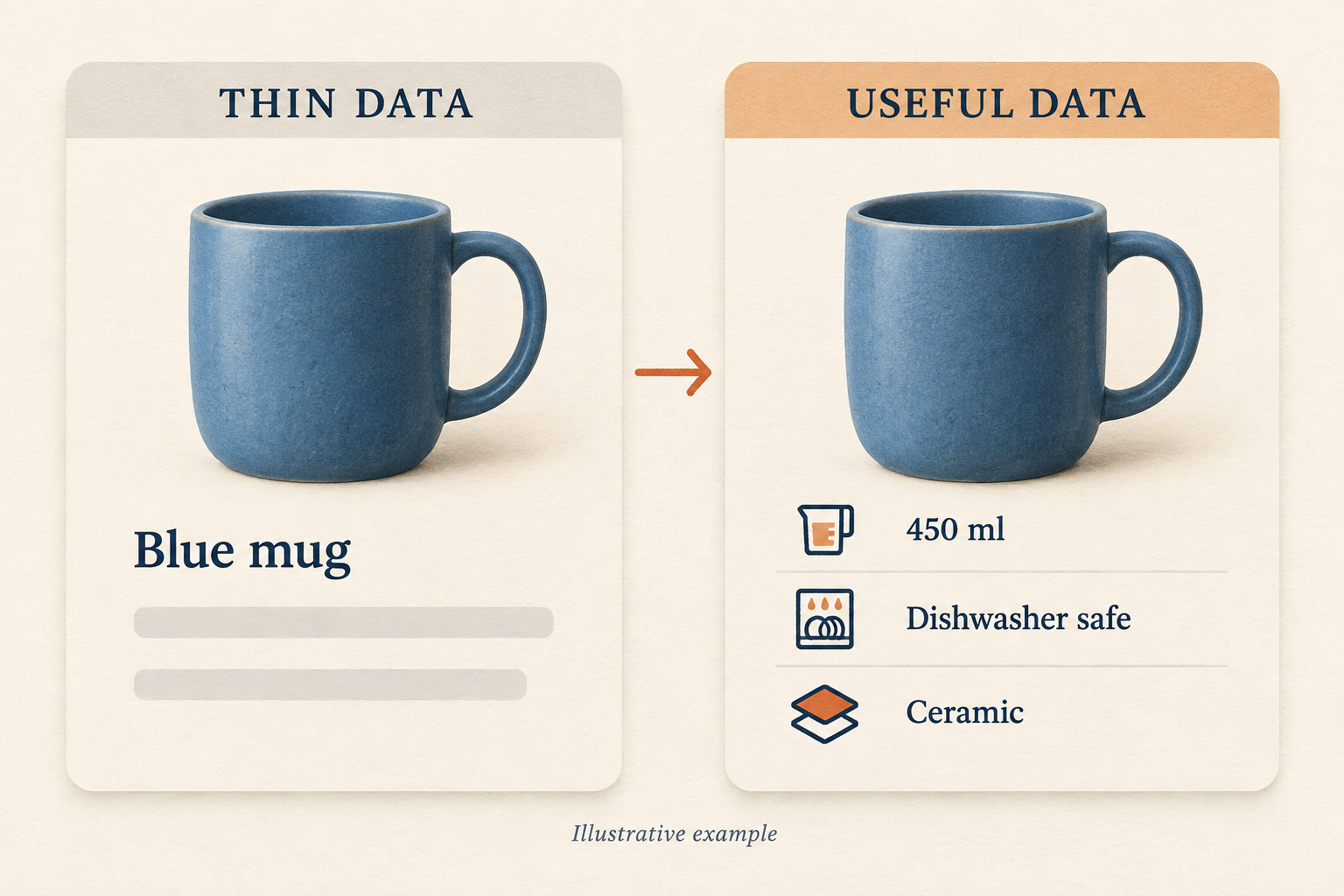
A ceramics store lists a mug as “Sunset Mug – Blue” with a two-line, mood-driven description. A shopper asks an AI assistant for “a large dishwasher-safe mug, around 450 ml, that keeps coffee warm.” The mug may fit, but nothing in its data says so. Now add a category, capacity in ml, dishwasher-safe and microwave-safe attributes, material, dimensions, an FAQ on heat retention, and reviews that mention the size. The product hasn’t changed. What’s changed is that a machine can now prove it fits the request.
Where this goes next
Platform strategies are still shifting (OpenAI’s checkout reversal proves it), and ACP and UCP will keep evolving. What stays constant across all of these systems is that an AI engine can only recommend what it can understand and trust. Complete, accurate and specific product data, backed by real reviews and real expertise, is useful to Google, ChatGPT, Perplexity, Copilot and whichever agent comes next.
For most catalogs, the hard part isn’t strategy. It’s the scale: thousands of SKUs with thin descriptions, empty attributes, missing alt text and no FAQs. That’s the problem we build for at Profitonium Apps. Our AI product description and bulk-editing tools help Shopify merchants fill those gaps across an entire catalog, and for larger stores we offer a done-for-you “AI-ready catalog” upgrade. If you’d like to know how AI-ready your catalog is, I’m happy to take a look.
Sources
- Aggarwal, P. et al. “GEO: Generative Engine Optimization.” KDD 2024. arXiv:2311.09735. Source
- Google. “Let AI do the hard parts of your holiday shopping.” Nov 13, 2025. Source
- Google. “Introducing the Universal Cart and more ways to help you shop.” May 19, 2026. Source
- Google. “New tech and tools for retailers to succeed in an agentic shopping era.” Jan 11, 2026. Source
- Google. “Boost your holiday sales with these agentic commerce updates.” Sep 16, 2026. Source
- Google Search Central. “Optimizing your website for generative AI features on Google Search.” May 15, 2026. Source
- Google Search Central. Product snippet structured data. Source
- OpenAI. “Buy it in ChatGPT: Instant Checkout and the Agentic Commerce Protocol.” Sep 29, 2025. Source
- OpenAI. “Powering Product Discovery in ChatGPT.” Mar 24, 2026. Source
- OpenAI Developers. Agentic Commerce product feed spec. Source
- CNBC. “OpenAI revamps shopping experience in ChatGPT after struggling with Instant Checkout offering.” Mar 24, 2026. Source
- The Verge. “ChatGPT now has 1.2 billion weekly users, OpenAI says.” Sep 29, 2026. Source
- PayPal. “PayPal and Perplexity Launch Instant Buy Ahead of Black Friday.” Nov 25, 2025. Source
- Shopify. “Introducing Shopify Agentic Storefronts.” Winter ’26 Edition, Dec 2025. Source
- Shopify. “The agentic commerce platform: Shopify connects any merchant to every AI conversation.” Jan 11, 2026. Source
- Shopify. “Millions of merchants can sell in AI chats.” Mar 24, 2026. Source
- Shopify Help Center. Agentic storefronts; Shopify Catalog and product discovery. Source
- Pew Research Center. “Google users are less likely to click on links when an AI summary appears in the results.” Jul 22, 2025. Source
- Ahrefs. “AI Overviews Reduce Clicks by 34.5%.” Apr 2025. Source
- Ahrefs. “Update: AI Overviews Reduce Clicks by 58%.” Feb 4, 2026. Source
- Ahrefs. “An Analysis of AI Overview Brand Visibility Factors (75K Brands Studied).” May 26, 2025. Source
- Ahrefs. “We Analyzed 137K Sites: 97% of llms.txt Files Never Get Read.” Jun 15, 2026. Source
- Seer Interactive. “AIO Impact on Google CTR: 2026 Update.” Apr 24, 2026. Source
- Adobe. “Holiday Shopping Season Drove a Record $257.8 Billion Online…” Jan 7, 2026. Source
- Adobe (Vivek Pandya). “AI-driven traffic surges across industries with retail experiencing biggest gains.” Jan 12, 2026. Source
- Reuters. “AI-referred US shoppers browse longer, spend more per visit, data shows.” Jun 15, 2026. Source
- TechCrunch. “Shopify says AI traffic is up 7x since January, AI-driven orders are up 11x.” Nov 4, 2025. Source
- The Motley Fool. Shopify (SHOP) Q4 2025 Earnings Call Transcript. Feb 11, 2026. Source
- Similarweb. “Similarweb’s 3rd Annual Global Ecommerce Report: Growth Shifts to Apps and AI.” Sep 15, 2025. Source
- Semrush. “AI Overviews are expanding across commercial intent search [Study].” Jul 2, 2026. Source
- BrightEdge. “Who Does AI Trust When You Search for Deals? Google vs. ChatGPT Citation Patterns.” Dec 3, 2025. Source
- The Motley Fool. Shopify (SHOP) Q2 2026 Earnings Call Transcript. Aug 2026. Source
- Profound. “ChatGPT 5.6 has transformed Shopping mode.” Sep 3, 2026. Source
Continue reading: Your Best Product Descriptions Are Quietly Making AI Skip You.
Originally published by Abhinav Panse on Medium.