
SEO guide
Your Best Product Descriptions Are Quietly Making AI Skip You: 6 Lessons From New Research
23 min read · Abhinav Panse · Updated
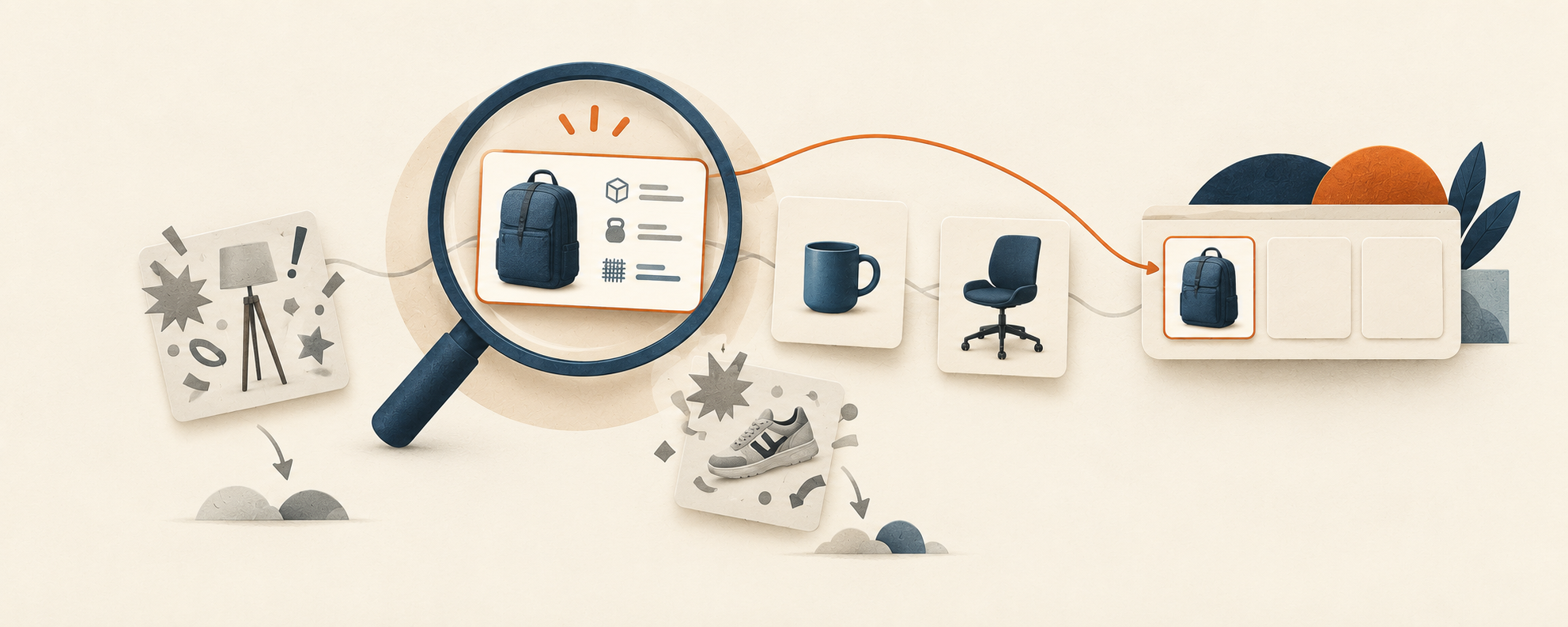
What new research says about how ChatGPT, Google, Amazon and AI shopping agents read your product descriptions, and how to write for a person and a machine at the same time.
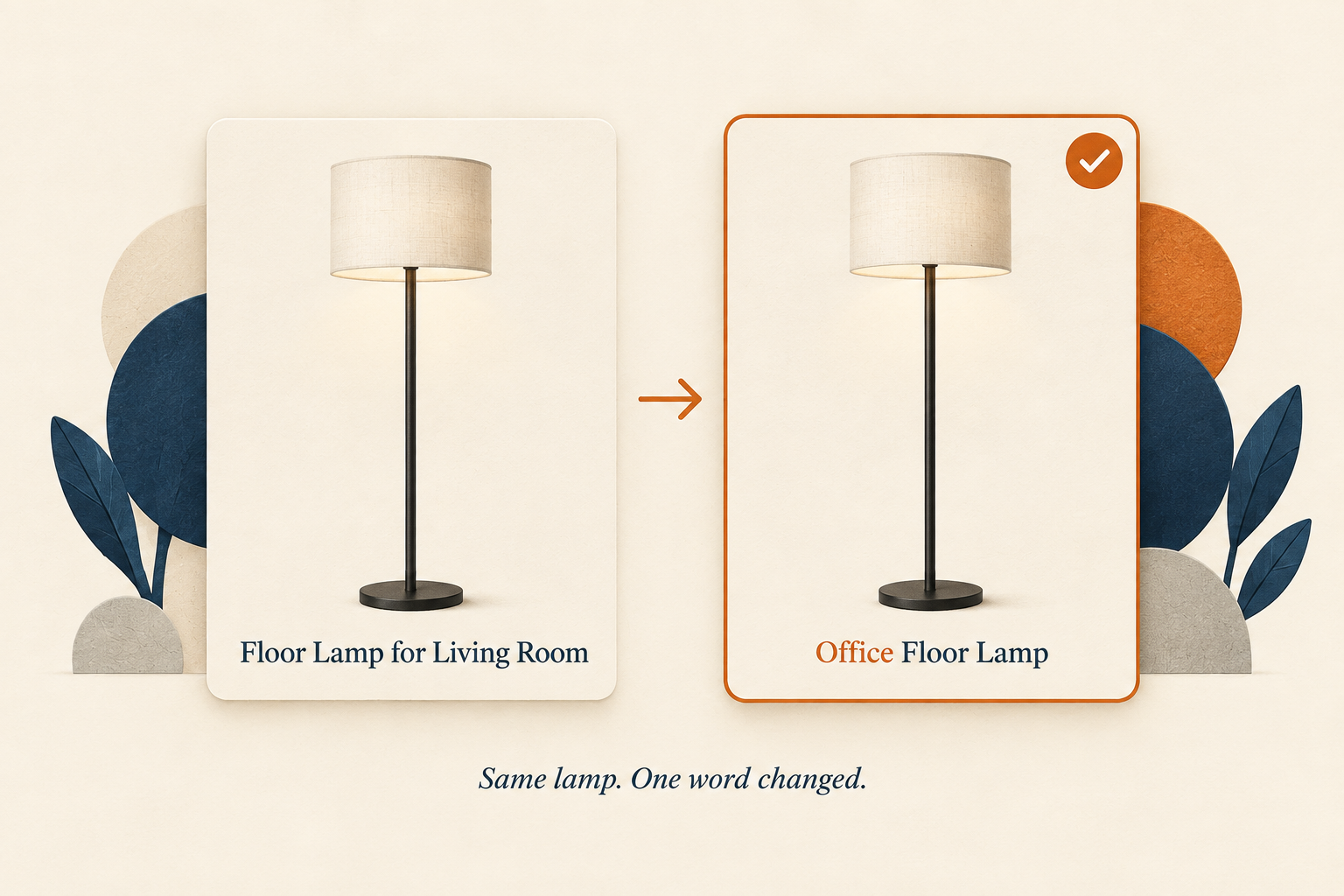
In 2025, researchers at Columbia ran an experiment I keep coming back to. They built a mock online store, put eight floor lamps on the page, and let AI shopping agents from OpenAI, Anthropic and Google pick one to buy. Then a seller agent changed one product title. "SUNMORY Floor Lamps for Living Room" became "SUNMORY Office Floor Lamp".
Same lamp. Same price. Same photo. Same reviews. GPT-5.1's agent chose it 80 percentage points more often. Gemini 2.5 Flash, 52 points more. Claude Opus 4.5, 41 points more (Allouah et al., 2025).
There's a catch, and I'll get to it. But the headline holds. A machine now reads your product descriptions before your customer does, and it has its own taste. It isn't the taste most copywriting courses teach, either. In the studies below, story-style descriptions, ad-style hype and "limited stock" urgency all pushed products down.
In my last post, I covered how AI engines are changing ecommerce discovery and shared a full AEO/GEO checklist for Shopify merchants. This one goes deeper on the one asset every one of those engines reads, rewrites and quotes: the product description. I build an app that writes product descriptions for Shopify stores, so I have a stake in this. That's exactly why I wanted to separate what the evidence says from what the GEO crowd is selling.
Why this matters more this quarter than last
A few numbers from the past few months:
- Adobe projects AI traffic to US retail sites will grow 130% year over year this holiday season (Adobe via Digital Commerce 360, Sep 29, 2026).
- Amazon says its Rufus shopping assistant was used by more than 300 million customers in 2025 and helped deliver nearly $12 billion in incremental annualised sales (Amazon Q4 2025 results, Feb 5, 2026). Rufus has since become "Alexa for Shopping", and Amazon says its US users spend over 40% more per order (Amazon Q2 2026 results, Jul 30, 2026).
- On Shopify's Q2 2026 call, management said half of all AI-referred sessions land directly on a product page, 2.5 times more often than with traditional search. AI searches powered by Shopify Catalog converted at twice the rate of searches using scraped data, which Shopify put down to products showing up complete and accurate (Shopify Q2 2026 call, Aug 5, 2026).
- In September, Meta joined ChatGPT, Google AI Mode, Gemini and Microsoft Copilot as an AI channel in Shopify admin. Products are shared with it by default through Shopify Catalog (Shopify changelog, Sep 8, 2026).
The usual reality check still applies. Contentsquare's 2026 benchmark of 99 billion sessions found AI-referred traffic was still just 0.2% of visits (Contentsquare, Apr 3, 2026). And Similarweb found that 89% of the time, shoppers who use AI for research also use regular search. In other words, people are stacking tools, not switching them (Similarweb, Sep 10, 2026).
So AI isn't replacing your other channels. It's being bolted onto the front of them. And if you're on Shopify, your product descriptions are most likely already going to ChatGPT, Google, Copilot and Meta by default, whether you've thought about it or not.
Who actually reads your description now
Here's what each major platform says about product text in its own documentation.
ChatGPT. OpenAI's help centre lists product descriptions among the structured data ChatGPT considers when choosing products. It also says ChatGPT may write its own simplified titles and descriptions, because merchants describe the same product in different ways, and that labels like "Budget-friendly" are generated by the model (OpenAI Help Center, updated Oct 2026). OpenAI's product feed spec asks for a factual, plain-text description of up to 5,000 characters and a title of up to 150 (OpenAI feed spec). Shopify merchants are covered through Catalog with no extra work.
Google. Merchant Center caps descriptions at 5,000 characters. It bans promotional text, comparisons with other products, all-caps emphasis and links, and asks merchants to put the most important details in the first 160 to 500 characters (Google Merchant Center Help). For AI Mode, Google now accepts a question_and_answer attribute with up to 30 question-and-answer pairs per product (Google Merchant Center Help).
Amazon. Amazon says Rufus searches product details, reviews and Q&A content. Its seller blog tells sellers to make sure descriptions answer frequently asked questions so Rufus can recommend their products (Amazon, Apr 29, 2026).
Shopify Catalog. Catalog sends your title, description, options, images, price and availability to AI channels. It can also pull the title, description and category from metafields (Shopify Help Center). Shopify is clear that being included doesn't guarantee placement. Each AI channel decides its own ranking and wording.
See the pattern? Every platform takes your description, and most of them rewrite it before a shopper sees a word. ChatGPT says so outright. So the job of your product description has changed. It used to persuade a person. Now it also has to hand a machine the facts it needs to describe, compare and recommend your product in its own words.
What the experiments say gets a product picked
Over 2025 and 2026, researchers started testing this directly, with AI models choosing between realistic product listings. Most of this work is preprints and lab setups, so treat it as strong hints, not laws. Still, the studies agree more than they disagree.
1. Length doesn't matter. Facts do.
The best ecommerce-specific study so far is E-GEO, from researchers at MIT and Columbia. They collected 13,747 real shopping requests from Reddit's r/BuyItForLife, paired each with 10 Amazon listings, and asked five AI models to rank them: GPT-5, Claude Sonnet 4.5, Gemini 3 Flash, DeepSeek V3.2 and Llama 4. The requests averaged about 59 words. Typical search keywords average about three words. People don't ask an AI for "durable backpack". They describe their life.
The researchers then rewrote the listings in different styles and measured how far each product moved (Bagga et al., updated Jul 2026):
- Longer descriptions had essentially zero correlation with rank. One rewriting model added about 170 words per listing and gained nothing.
- Rewriting a description as a story, which the researchers used as a deliberate worst case, dropped products about four places in a top-10 list. Ad-style descriptions dropped them one to two places. Persuasive, "authoritative" and minimalist rewrites also hurt.
- Only four styles roughly matched or beat the original: FAQ format, clear headings and bullets, a style focused on the product's competitive strengths, and one that copies the format of an AI's own answers.
The best-performing rewrite prompts, found by automated search, all landed on the same recipe. Keep every fact. Surface concrete attributes. Organise information so it's easy to compare. Use the words a buyer would use. Group content into key features, benefits and typical use cases. Add buyer questions. Make no unsupported claims. Those prompts improved on their starting rewrite styles in 63 of 75 prompt-and-model tests, including on Claude, a model family they weren't tuned on. Many results still fell below the original listings.
Read that recipe again. It's just a good product description. The machine wants what a careful shopper wants.
2. The first few words carry the most weight
Back to the lamp. Here's the catch. In the Columbia mock store, titles were cut off on the results grid, so the word "Office" was never visible before the change. The win came from putting the word buyers were looking for where the agent could actually see it.
The same study found smaller but real wins from front-loading specs. Adding "2-Ply, Septic-Safe, Unscented" to a toilet paper title raised GPT-5.1's selection rate by 15.5 points. Moving "with 1,250 Staples" to the front of a stapler title raised selection by 9.5 points in another test. The improved descriptions weren't shorter. They just put the most relevant words first (Allouah et al., Dec 2025).
Other studies point the same way. C-SEO Bench, a NeurIPS 2025 benchmark, found that on retail product queries, a short summary placed at the top of a description was one of the very few rewrites that significantly improved ranking (Puerto et al., 2025). SAGEO Arena, accepted at KDD 2026, found that putting the answer early in a page raised its score when the AI re-ranks results (Kim et al., 2026). And Google's own feed rules ask for the key details in the first 160 to 500 characters.
3. Hype, scarcity and fancy words backfire
Bias Beware, a study accepted at EMNLP 2025, tested classic marketing psychology inside product descriptions on several AI recommenders. Social proof helped. Scarcity lines like "only a few left" and exclusivity language, to the authors' surprise, made products less likely to be recommended (Filandrianos et al., 2025).
SAGEO Arena found something I didn't expect. Shopping was the only domain in its tests where every rewriting method made pages less likely to be cited, because product pages are usually well organised already. Swapping everyday words for rare or technical ones caused the biggest drops, because the AI's search step stopped matching them to how people ask. Their example: rewriting "sleeping" as "somnolence" (Kim et al., 2026).
And the original GEO paper, which I covered last time, found keyword stuffing gave little to no improvement, and did worse than doing nothing on Perplexity (Aggarwal et al., KDD 2024).
So the old copywriting reflexes, like "Hurry, limited stock!", "the ultimate luxury experience", or "best cheap waterproof jacket men women" stuffed into the description, now carry a second cost. They annoy people, and they read as noise to the machine.
4. Ratings and reviews move AI agents a lot
Using the Columbia study's estimates, a product with a 10% baseline chance of being picked would rise to roughly 15% to 20% after a 0.1-star rating increase, depending on the model. Doubling the review count was worth as much as a 17% to 37% price increase. A "Sponsored" tag slightly lowered selection, while a platform badge like "Overall Pick" roughly doubled it, or more (Allouah et al., 2025).
A June 2026 preprint on skincare found something similar about brands. AI models recommended well-known brands every time when all the specs were identical, but that advantage disappeared once a lesser-known competitor had a rating edge of less than 0.1 stars (Chu & Hou, 2026). It's one study on one category, but it's good news for smaller brands.
Shoppers say the same thing. In Syndigo's 2026 survey of 8,736 adults across six countries, ratings and reviews, chosen by 53%, and detailed product descriptions, chosen by 52%, were the top two purchase drivers, ahead of discounts (Syndigo, Aug 19, 2026).
Reviews aren't part of your description, but they're part of the same record the AI reads. Rufus reads them. ChatGPT builds review summaries from public websites. OpenAI's feed has fields for review count and star rating.
5. Make the deciding facts easy to find
A September 2026 study ran eight commercial AI models from three providers as shoppers. When every product detail was visible, pricing tricks like $9.99 endings and "% off" framing rarely fooled them. But when finding details took extra steps and the shopping goal was vague, the agents skipped the details they needed to work out unit price, like weight, and made worse choices. The authors concluded these mistakes depend more on how a store presents its information than on flaws in the AI (Wadi & Ma, Sep 2026).
For a merchant, the lesson is simple. If a shopper needs a fact to decide, like size, weight, quantity, capacity or compatibility, put it in plain text where an agent will read it on the first pass. Don't leave it only inside an image, a tab or a size-chart PDF.
6. Results swing between models, and between runs
This is the part GEO sales decks leave out. In the Columbia study, one round of AI rewriting raised market share for five of six buyer models, by up to about 15 points. But in 67% of category-and-model pairs, the rewrite made no significant difference, and a few rewrites backfired. The authors' warning was blunt: "sellers cannot simply 'set and forget' AI-generated descriptions" (Allouah et al., 2025).
A September 2026 audit of ChatGPT, Gemini and Google AI Overviews found that recommended products often changed when the same question was asked again. ChatGPT and Gemini shared only about 5% of their cited domains for the same query (Uberti-Bona Marin et al., Sep 2026). And a July 2026 review of 45 GEO studies concluded that no technique has yet shown a stable, long-term, cross-platform effect on discoverability (Martinez, Jul 2026).
My take: anyone promising you "rank #1 in ChatGPT" is guessing. What the evidence supports is narrower, and more useful. Once an AI has found your product, a clear, specific, honest description improves your odds of being chosen, on most models, most of the time.
The AI-written description trap
Here's the irony. The fastest way to fix thousands of thin descriptions is AI. The fastest way to make them worse is also AI.
Three warnings from the platforms themselves:
- Shopify's help page says its own description generator may add product benefits you never listed, and facts drawn from content about similar products. You're responsible for the accuracy of everything you publish (Shopify Help Center).
- Google's guidance on generative AI content, updated Oct 1, 2026, tells site owners to fact-check AI output by hand, including titles, meta descriptions, structured data and image alt text. In Merchant Center, AI-generated titles and descriptions must go in separate structured_title and structured_description attributes, labelled as AI-generated (Google Search Central; Google Merchant Center Help).
- Google's spam policy counts using AI to churn out many pages without adding value for users as scaled content abuse (Google Search Central, updated Aug 28, 2026).
To be fair to AI, Google isn't against it as such. Ahrefs studied 600,000 ranking pages in 2025 and found almost no correlation between how much AI-written content a page had and where it ranked (Ahrefs, Jul 7, 2025). What matters is whether the description is true and useful, whoever wrote it.
The research adds one more warning. The model and the instructions matter. In E-GEO, the same simple "make this rank higher in an LLM" prompt helped when GPT-5 or Claude did the rewriting and hurt when GPT-4o-mini did it (Bagga et al., 2026).
Made-up specs aren't just embarrassing, either. Amazon's own researchers have warned that a hallucinated listing could, for example, leave out a choking-hazard warning on a toy and create legal exposure (Jiang et al., ECNLP 2024). On the shopper side, 45% of people in Salsify's 2026 survey said they had returned an online purchase because of incorrect or misleading information (Salsify, Jan 21, 2026).
So here's the rule I'd give any merchant. Let AI write. Never let it invent. Feed it facts: your specs, metafields, materials, dimensions and real customer questions. Then check every output against the product. An AI writing from a product title alone fills gaps with plausible guesses, and plausible guesses are exactly what cost you with returns, with Google and now with other AIs.
Anatomy of a description written for two readers
Putting the research and the platform rules together, this is the structure I'd use. It works for a person skimming on a phone and for an agent comparing 40 options in a second.
- Title. Brand, then the product type in the words buyers use, then the attribute that decides the purchase, then the variant. Put the important words in the first 70 characters, because Google says people typically see 70 or fewer. Stay under 150.
- Opening summary, in the first 160 to 500 characters. What it is, who it's for, and the two or three facts that decide the purchase. If an AI reads only this paragraph, it should still be able to recommend you correctly.
- Key specs as bullets, with units. Dimensions, weight, capacity, materials, compatibility and what's in the box. Everything a shopper needs to compare you or work out a unit price.
- Use cases, and who it isn't for. Amazon's COSMO research maps shopping queries to intent, such as who a product is for, where it's used and what it goes with. Their example is a search for "shoes for pregnant women" leading to slip-resistant shoes (Yu et al., SIGMOD 2024). State those links plainly. An honest "not ideal for" line builds trust with people and gives an AI a reason to recommend you for the right request.
- Three to six real FAQs. Pull them from support tickets, reviews and pre-sale chats. Amazon tells sellers to do exactly this for Rufus, and in E-GEO the FAQ format held its ground when most other rewrites lost.
- Care, warranty and returns. Short, specific and factual.
And here's what to leave out: superlatives you can't back up, fake urgency, "exclusive" language, comparisons with named competitors, which Google's feed rules ban, keyword lists, rare words where a common one exists, and anything hidden from people but aimed at AI. Researchers have shown that hidden instructions can steer AI search (Nestaas et al., ICLR 2025). That's an attack, not optimisation, and platforms are building defences against it.
A hypothetical before and after
The following is hypothetical, for illustration only.
Before
The Wanderer
Your new favourite adventure companion. Crafted with love for those who dare to explore. Premium quality you can feel. Limited stock, grab yours before it's gone!
A shopper asks an AI assistant for a carry-on backpack that fits a 16-inch laptop, copes with rain, and works for a four-day work trip. Nothing in that description mentions capacity, laptop size, water resistance or dimensions. The bag might be perfect. The AI can't prove it.
After
Wanderer 35L Carry-On Travel Backpack, Water-Resistant, 16" Laptop Sleeve, Black
A 35-litre cabin-size backpack for 3 to 5 day trips, with a padded sleeve for laptops up to 16 inches and a water-resistant shell for wet commutes.
- Capacity: 35 L
- Size: 55 × 35 × 20 cm. Fits many airlines' cabin-bag limits, but check yours before flying.
- Weight: 1.3 kg
- Material: 600D recycled polyester with a water-resistant coating. Not fully waterproof.
- Laptop sleeve: padded, fits laptops up to 16"
- Opens flat like a suitcase, with lockable main zips
Good for: work trips, weekend city breaks, and commuters who carry a laptop.
Not ideal for: budget-airline fares that only allow a small under-seat bag.
FAQ
Will it fit under the seat on budget airlines? Usually not. It's a cabin-size bag for the overhead bin.
Is it waterproof? It's water-resistant. It handles rain on a commute, not a dunk in a lake.
Does it fit a 16-inch MacBook Pro? Yes. The sleeve fits laptops up to 16 inches.
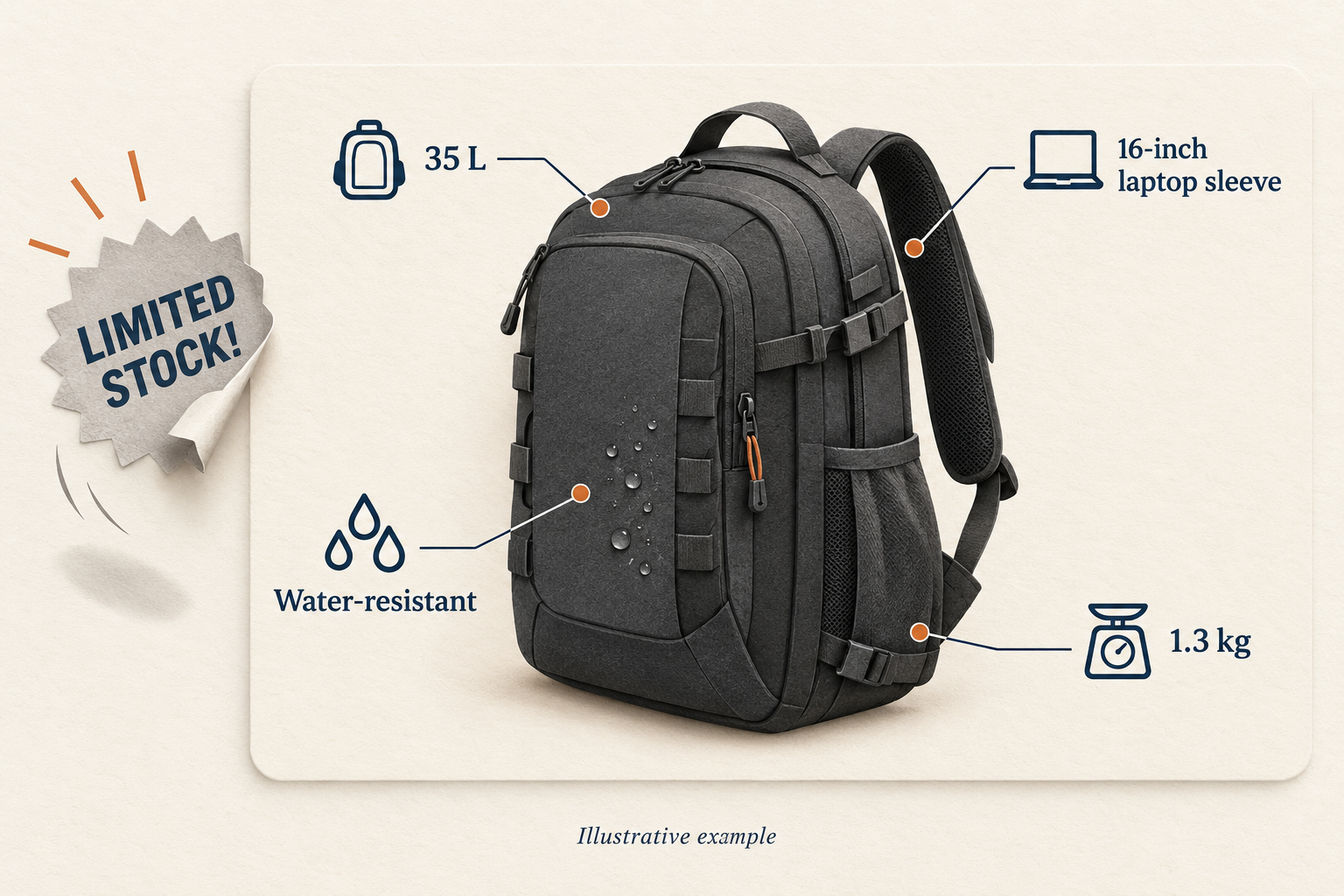
The bag hasn't changed. What changed is that a person can decide in ten seconds, and a machine can match it to the request with evidence. It's also honest about what the bag won't do. That's what earns trust from the shopper it isn't right for, and it saves you a return.
The description checklist
Written for Shopify, but it applies anywhere.
- Rewrite titles. Brand, product type in buyer language, the deciding attribute, then the variant. Keep the important words in the first 70 characters.
- Open with a summary. Start every description with two or three factual sentences that say what it is, who it's for and why.
- Turn spec paragraphs into bullets with units. Move facts out of images and size-chart graphics into plain text.
- Add use cases and an honest "not ideal for" line.
- Add three to six FAQs drawn from real customer questions. For store-level questions about shipping, returns and policies, the free Shopify Knowledge Base app lets you set the answers AI agents use. Shopify says it improves accuracy, not how often you appear.
- Map your metafields. If key facts live in metafields, use Shopify Catalog Mapping so AI channels actually get them.
- Delete the noise. Cut fake urgency, unsupported superlatives, keyword lists and competitor comparisons.
- Use AI with real data. If AI writes your descriptions, give it real product data and review every output against the product. Label AI-generated text correctly in Merchant Center.
- Keep collecting reviews. In lab tests, a tenth of a star moved AI agents.
- Test with real prompts. Ask ChatGPT, Gemini and Perplexity the questions your customers ask, several times each. Note whether you show up and how you're described. One screenshot proves nothing.
- Recheck after big model releases. In the Columbia study, the same product's share swung widely between model versions.
Where this leaves us
In my last post I wrote that an AI engine can only recommend what it can understand and trust. The description is where that gets won or lost. Syndigo's CEO made a similar point this summer: AI won't recommend what it can't verify.
There's real upside for smaller brands here. Shopify said 75% of AI-attributed orders in Q2 came from outside its top 100 categories. In the lab, one well-placed word or a tenth of a star moved AI agents more than most copywriting tricks did. You don't need a famous name to be the product the AI can prove fits.
The hard part, again, is scale. Writing one great description is easy. Writing 4,000 of them accurately from real product data, and keeping them current as models change, is the actual job. That's what we build at Profitonium Apps. Our AI Product Description app for Shopify writes descriptions, titles, SEO metadata and image alt text in bulk, and can draw on product images, metadata and web search to stay factual. If you'd like a second pair of eyes on how your catalog reads to an AI, I'm happy to take a look.
Previous post: Your Next Customer Won't See Your Store First. Their AI Will.
Sources
Research papers
- Allouah, A., Besbes, O., Figueroa, J. D., Kanoria, Y., Kumar, A. "What Is Your AI Agent Buying? Evaluation, Biases, Model Dependence, & Emerging Implications for Agentic E-Commerce." arXiv:2508.02630, v1 Aug 4, 2025; v3 Dec 2025. https://arxiv.org/abs/2508.02630
- Bagga, P. S., Farias, V. F., Korkotashvili, T., Peng, T., Wu, Y. "E-GEO: A Testbed for Generative Engine Optimization in E-Commerce." arXiv:2511.20867, v1 Nov 25, 2025; v2 Jul 14, 2026. https://arxiv.org/abs/2511.20867
- Puerto, H., Gubri, M., Green, T., Oh, S. J., Yun, S. "C-SEO Bench: Does Conversational SEO Work?" NeurIPS 2025 Datasets & Benchmarks. arXiv:2506.11097. https://arxiv.org/abs/2506.11097
- Kim, S., Jeong, W., Kim, S., Lee, S., Lee, D. "SAGEO Arena: A Realistic Environment for Evaluating Search-Augmented Generative Engine Optimization." KDD 2026. arXiv:2602.12187. https://arxiv.org/abs/2602.12187
- Filandrianos, G. et al. "Bias Beware: The Impact of Cognitive Biases on LLM-Driven Product Recommendations." EMNLP 2025. arXiv:2502.01349. https://arxiv.org/abs/2502.01349
- Chu, X., Hou, Y. "Incumbent Advantage: Brand Bias and Cognitive Manipulation Dynamics in LLM Recommendation Systems." arXiv:2606.17443, Jun 16, 2026 (preprint). https://arxiv.org/abs/2606.17443
- Wadi, D., Ma, Y. "Shopping by algorithm: How agentic AI deploys human heuristics as a surrogate consumer." arXiv:2609.28372, Sep 23, 2026 (preprint). https://arxiv.org/abs/2609.28372
- Uberti-Bona Marin, L. G. et al. "'If I Had to Buy Just ONE: Galaxy S26 Ultra': Auditing AI-Generated Product Recommendations." arXiv:2609.18729, Sep 16, 2026 (preprint). https://arxiv.org/abs/2609.18729
- Martinez, O. "Optimizing Visibility in Generative Engines: A Critical Survey of Generative Engine Optimization (2023-2026)." arXiv:2607.14035, Jul 15, 2026 (preprint). https://arxiv.org/abs/2607.14035
- Aggarwal, P. et al. "GEO: Generative Engine Optimization." KDD 2024. arXiv:2311.09735. https://arxiv.org/abs/2311.09735
- Nestaas, F., Debenedetti, E., Tramèr, F. "Adversarial Search Engine Optimization for Large Language Models." ICLR 2025. arXiv:2406.18382. https://arxiv.org/abs/2406.18382
- Yu, C. et al. "COSMO: A Large-Scale E-commerce Common Sense Knowledge Generation and Serving System at Amazon." SIGMOD-Companion 2024. https://cdn.amazon.science/19/5d/bde30d0d4019be6421e79e50cda9/cosmo-paper.pdf
- Jiang et al. "Hallucination Detection in LLM-enriched Product Listings." ECNLP 7, 2024. https://aclanthology.org/2024.ecnlp-1.4.pdf
Platform documentation
- OpenAI Help Center. "Shopping with ChatGPT Search." Updated Oct 2026. https://help.openai.com/en/articles/11128490-shopping-with-chatgpt-search
- OpenAI Developers. Agentic Commerce product feed spec. https://developers.openai.com/commerce/specs/file-upload/products
- Google Merchant Center Help. Description [description] attribute. https://support.google.com/merchants/answer/6324468
- Google Merchant Center Help. Title [title] attribute. https://support.google.com/merchants/answer/6324415
- Google Merchant Center Help. Question and answer [question_and_answer] attribute. https://support.google.com/merchants/answer/17085211
- Google Search Central. "Using generative AI content on your website." Updated Oct 1, 2026. https://developers.google.com/search/docs/fundamentals/using-gen-ai-content
- Google Search Central. Spam policies for Google web search. Updated Aug 28, 2026. https://developers.google.com/search/docs/essentials/spam-policies
- Amazon. "How to boost Amazon listings to drive more sales: 10 tactics." Apr 29, 2026. https://sell.amazon.com/blog/how-to-boost-amazon-listings
- Shopify Help Center. Shopify Catalog and agentic storefronts. https://help.shopify.com/en/manual/online-sales-channels/agentic-storefronts/products
- Shopify Help Center. Generating product descriptions. https://help.shopify.com/en/manual/products/details/product-descriptions/generate
- Shopify Help Center. Knowledge Base app. https://help.shopify.com/en/manual/promoting-marketing/knowledge-base
- Shopify Changelog. "Meta is now an AI channel in your admin." Sep 8, 2026. https://changelog.shopify.com/posts/meta-is-now-an-ai-channel-in-your-admin
Market data
- Digital Commerce 360. "Adobe projects 2026 online holiday sales will reach $275 billion." Sep 29, 2026. https://www.digitalcommerce360.com/2026/09/29/adobe-projection-2026-online-holiday-sales-275-billion/
- Amazon. Q4 2025 earnings release. Feb 5, 2026. https://s2.q4cdn.com/299287126/files/doc_earnings/2025/q4/earnings-result/AMZN-Q4-2025-Earnings-Release.pdf
- Amazon. Q2 2026 earnings release. Jul 30, 2026. https://s2.q4cdn.com/299287126/files/doc_earnings/2026/q2/earnings-result/AMZN-Q2-2026-Earnings-Release.pdf
- The Motley Fool. Shopify (SHOP) Q2 2026 earnings call transcript. Call held Aug 5, 2026. https://www.fool.com/earnings/call-transcripts/2026/08/12/shopify-shop-q2-2026-earnings-call-transcript/
- Contentsquare. "AI-referred traffic." Apr 3, 2026. https://contentsquare.com/blog/ai-referred-traffic/
- Similarweb. "State of Ecommerce 2026." Sep 10, 2026. https://ir.similarweb.com/news-events/press-releases/detail/160/similarweb-state-of-ecommerce-2026-report-details-how-ai-is-changing-shopper-journey
- Syndigo. "State of Product Experience 2026." Aug 19, 2026. https://syndigo.com/news/state-of-product-experience-2026-proof-beats-price
- Salsify. 2026 Consumer Research. Jan 21, 2026. https://www.salsify.com/press-release-salsify-consumer-research-2026-daily-online-shopping-plunges-shoppers-return-to-certainty-of-stores
- Ahrefs. "AI-Generated Content Does Not Hurt Your Google Rankings." Jul 7, 2025. https://ahrefs.com/blog/ai-generated-content-does-not-hurt-your-google-rankings/
Originally published on Medium.